The Ultimate Mistake
On Monday, 19 October 2026, I was honoured and privileged to be appointed an Adult Education Fellow (AEF) by the Institute for Adult Learning (IAL) under the Training and Adult Educator Professional Pathway (TAEPP). The inaugural cohort of 12 AEFs was appointed at the “Skills-First: Framework for Action” launch conference.
For some 20 years, I have been teaching at the Lee Kuan Yew School of Public Policy, National University of Singapore, and it has been a wonderful experience. However, I have also always desired to have a pathway to reach out to all learning adults, rather than be limited to those attending courses at the Lee Kuan Yew School.
Hence, becoming an AEF is an exciting milestone for me because it opens the way for me to teach motivated adult learners. I am eager to share practical insights that will meaningfully benefit their careers and day-to-day lives.
The world of leadership and continuous preparation for the future is for everyone who seeks to be the best he or she can be.
The Most Important Skill
I believe the most important skill schools need to teach their students is the capability to solve problems; and I am referring to schools all the way from kindergarten to university!
You may ask: “Capability to solve what problems?”
That is exactly the point. It cannot be good enough for students to learn how to solve the problems they face while they are in school; they need to be able to solve whatever problems they face after they leave school, and for the rest of their lives.
Since we cannot tell what are the problems they would face after they leave school, the solution obviously cannot be just to teach them the formulas for solving the problems of their days in school.
Imbibing Social Responsibility and the Right Values, Spirit, and Attitude
The solution lies in imbibing in them social responsibility and the right values, and generating in them the right spirit and the right attitude to solve whatever problems they face in life.
It is about building up self-confidence, resilience, tenacity, curiosity, innovativeness, creativity, openness to ideas, willingness to learn, ability to communicate, high levels of personal energy, capacity to work with others, and so on.
Of course this is a very tall order! And it is not only for those currently in school, but also for those in the workforce today.
And is this “tall order” doable?
I believe it is. But it needs teachers and leaders who see this matter of culture and attitude as an existential issue for our future, and who are willing to lead, teach, and encourage through mistakes and failures.
Prepare to Deal with “Unknown Unknowns”
On 19 October 2026, I also had the opportunity to participate in a UBS thought-leadership event. The fireside chat was entitled: “Future Readiness of Nations: What Differentiates Resilient Nations from Vulnerable Nations?”
It covered a range of topics, such as what makes nations resilient, the changing world order, and preparing for the unknown. It was opportunity to reflect on how Singapore came to succeed against all odds.
In today’s volatile, uncertain, complex, and ambiguous world, it is not good enough to think of how to deal with the “known knowns” and the “known unknowns”. To survive and succeed, we need leaders who are obsessed with preparing his or her team to deal with “unknown unknowns”.
One such leader was one of my master teachers and one of the greatest leaders in Singapore’s history, Dr Goh Keng Swee.
Lessons from Dr Goh Keng Swee
Dr Goh Keng Swee was Singapore's first Minister for Finance, and the architect of Singapore’s economy, defence, and security. As mentioned by Singapore’s founding Prime Minister, the late Mr Lee Kuan Yew, in his 2010 eulogy for Dr Goh, it was Dr Goh “who made the greatest difference to the outcome for Singapore”.
The years I spent working with Dr Goh Keng Swee from 1970 to 1978 were exhilarating.
As I shared in my memoirs, “Lim Siong Guan: The Best is Yet to Be”, there was a vibrancy, energy, and urgency in Dr Goh’s leadership that either incited one to action or cowered one to inaction.
No one lasted long under Dr Goh if they feared to try due to their inexperience or the uncertainties of the time. His willingness to try new things ignited the rise of self-confidence, and the gumption to confound cynics and sceptics.
I learnt many important life and leadership lessons from Dr Goh such as:
The art of getting things done in situations of ambiguity and uncertainty.
The importance of having the courage to try new things, and the discernment to cut losses when things do not work out.
How to think clearly, and to never camouflage ambiguity and uncertainty with words.
The need to set goals that may be a stretch, but still achievable with effort and imagination.
The need to be open to good ideas from anywhere.
The necessity of having an indomitable spirit to be the master of our own destiny.
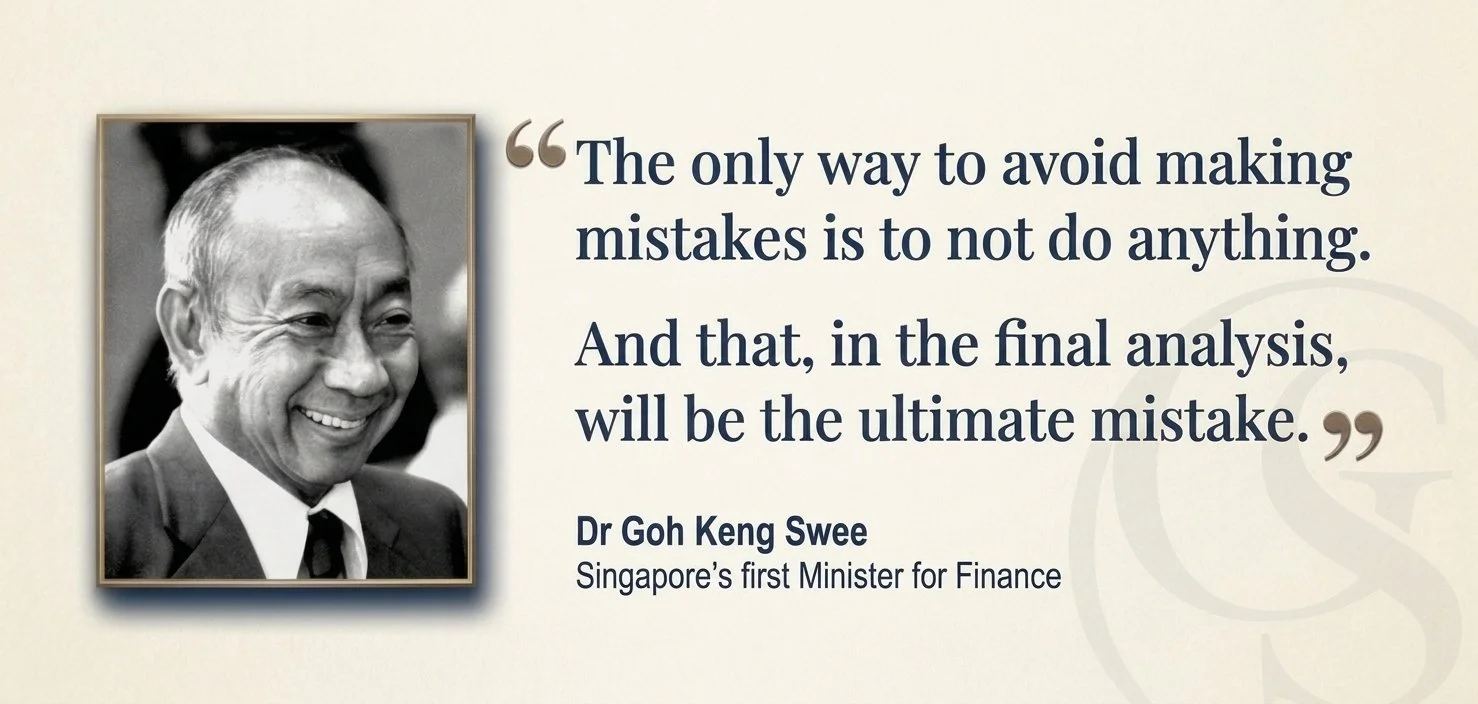
Above all, I learned from Dr Goh that:
“The only way to avoid making mistakes is to not do anything;
and that, in the final analysis, will be the ultimate mistake.”
Making mistakes is never the problem
Making mistakes is never the problem. Knowing you have made a mistake, correcting what you can, and learning from it is key.
May you dare to try, and try again!
The best is yet to be!
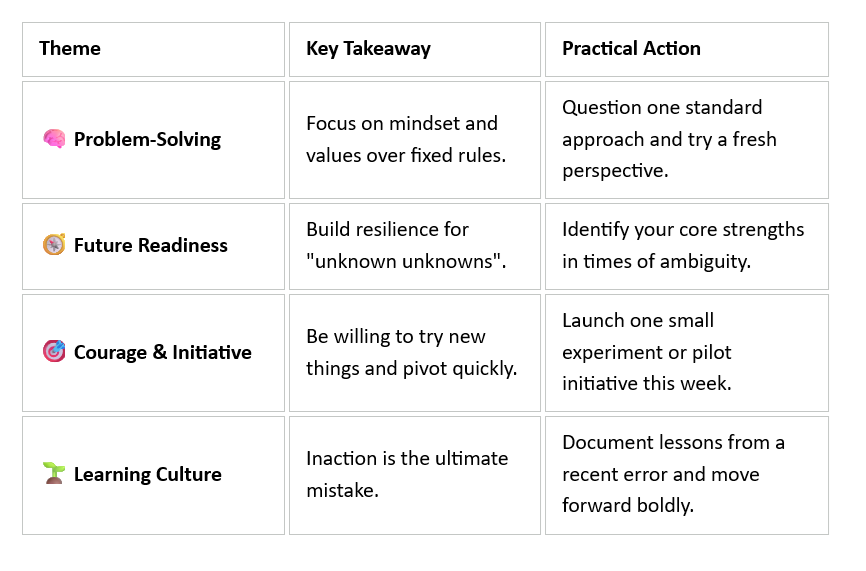
💡 Action Summary Matrix for This Week
Share your thoughts with us at Hello@LimSiongGuan.sg.
Text edited and image generated by Joanne H. Lim.
_______________________________________________________________________________________
✨ Let's Connect! ✨
📬 Email Hello@LimSiongGuan.sg
🌐 Website www.LimSiongGuan.sg
📝 Previous Blog Be Yourself
👥 Facebook Lim Siong Guan Official